
Do You Know Where Your Vessels’ Port Time Goes?
Modern shipping operations run on data. But do you truly know where your vessels’ port time goes?
The 2025 U.S. Gulf & East Coasts Tanker Ports Benchmark Report provides an unprecedented, data-driven look into port performance across nine major ports, analyzing Port Turnaround Time (PTT) as the ultimate indicator of system-wide efficiency.
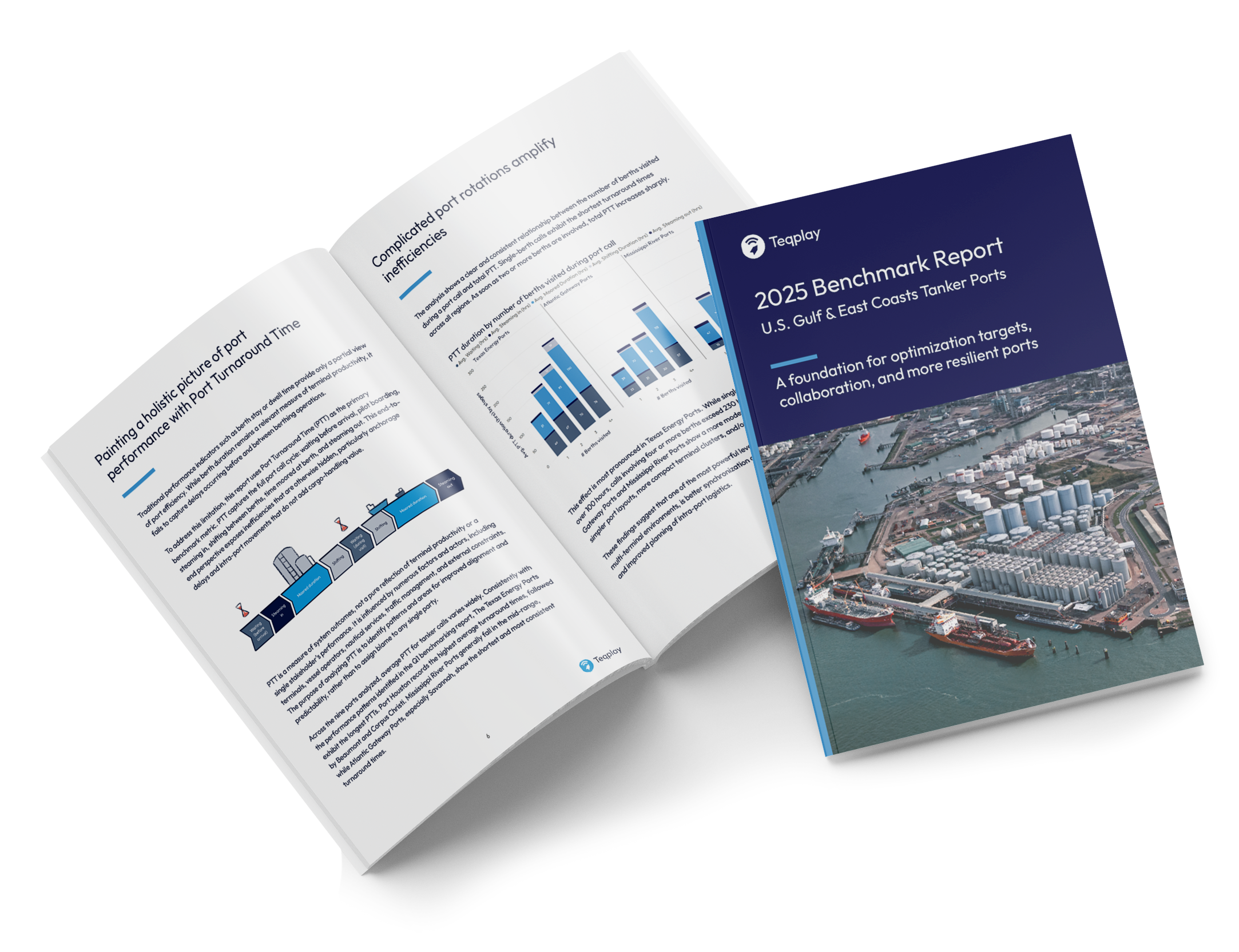
What this shipping report reveals
Using AIS-powered analytics from more than 10,000 port calls and 12,000 berth visits, the report identifies significant patterns shaping operational efficiency along the Gulf and East Coasts.
Key findings show that while productive berth time represents ~40-70% of total turnaround time, the rest is consumed by waiting before arrival, intra-port shifting, and idle periods.
Notably, Texas Energy Ports, including Port Houston, recorded the longest average PTT, while Atlantic Gateway Ports and Mississippi River Ports demonstrated shorter, more predictable port calls. Compared with Q1 results, overall turnaround times improved, suggesting an easing of delays as coordination strengthened throughout 2025.
Where time is lost and how to get it back
The data makes one thing clear: alignment matters more than capacity.
Vessels arriving at occupied berths experience average waiting times nearly double those of vessels arriving when a berth is available. This shows that synchronizing vessel arrivals with berth readiness offers one of the biggest opportunities for performance gains.
The report highlights Port Houston and Port Beaumont as having the most to gain from improved alignment through:
- Predictive berth planning
- Shared real-time status visibility
- Just-in-Time (JIT) arrival coordination
- Cross-terminal scheduling
For a Medium Range tanker, cutting PTT by just one day can save up to $25,000 in charter costs, 20 tonnes of fuel, and 65 tonnes of CO2 emissions.
Complex port rotations multiply inefficiencies
Multi-berth calls add complexity and delay. The analysis shows that while single-berth visits average just over 100 hours, calls involving four or more berths exceed 230 hours, often due to shifting and idle periods between terminals.
Reducing unnecessary shifting is both a vessel-efficiency and port-capacity strategy. Each avoided movement saves pilots, tugs, and fuel, contributing directly to both profitability and sustainability.
Building resilient and predictable ports
Weather disruptions, such as the fog-related delays in early 2025, remind us that external conditions will always affect operations. But digital visibility, predictive analytics, and collaborative planning tools allow ports to mitigate impacts, maintain reliability, and recover faster.
The shipping report concludes that ports reducing PTT consistently outperform peers in cost efficiency, emissions, and service predictability, while strengthening long-term competitiveness.
Are you ready to expose & eliminate waste and risk in ports?
Get the full 2025 Report to benchmark your port’s performance, identify improvement opportunities, and strengthen your operational resilience.

Léon Gommans | CEO/Co Founder of Teqplay
A serial entrepreneur who’s passionate about #innovation, #technology, #collaboration, and of course, #maritime. The mission is: to connect the dots & to get it to work, together with the industry!
- +31 (0)6 55306660
- leon@teqplay.com
- Léon Gommans